Traditional networking often relies on rigid taxonomies: hubs, switches, routers, etc., each with a static definition. However, this fails when encountering modern, multi-function devices that defy these categories. A more effective way to understand the functionality of various network devices is to shift the question from “What is this device?” to “What information does this device use to decide where to forward traffic”
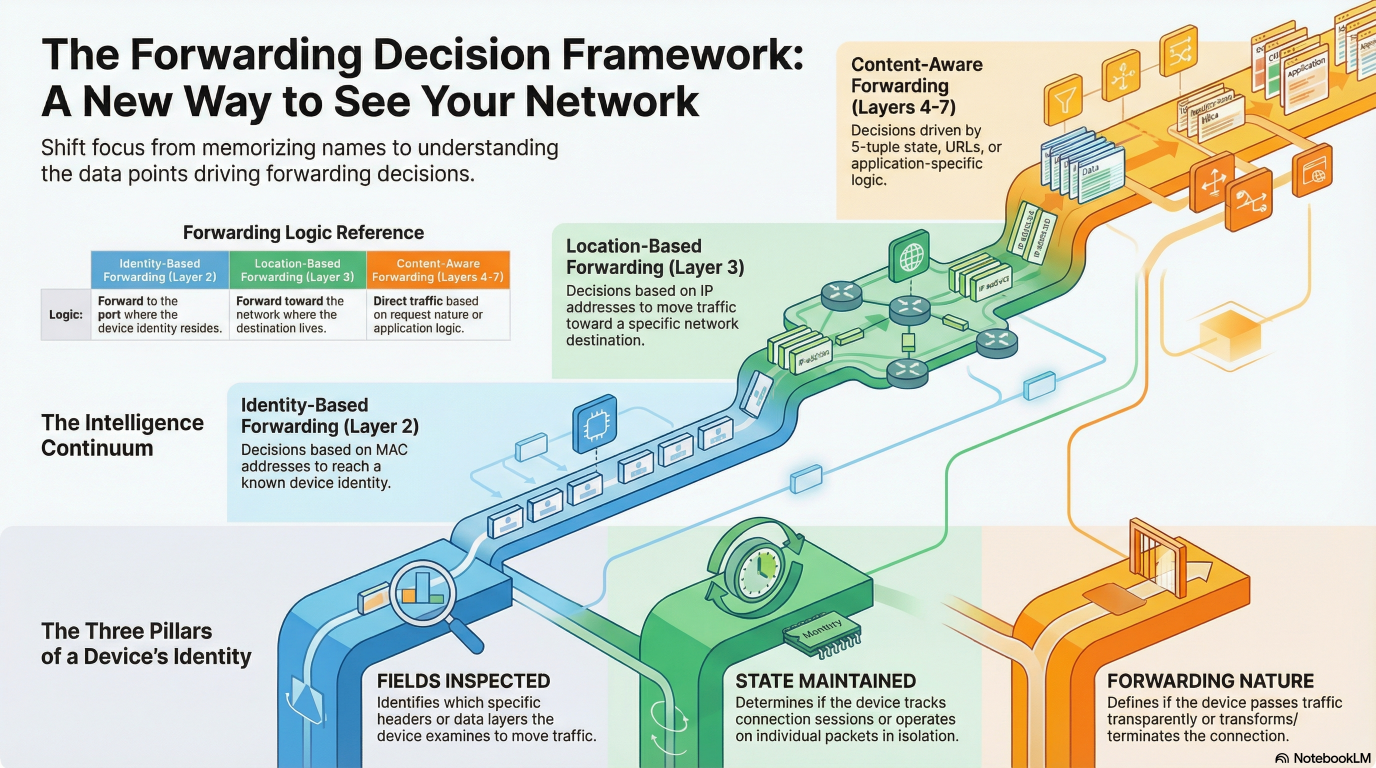
This question reframes how we understand network infrastructure.
The Core Differentiators
At its essence, any intermediate network device performs one core function: it receives traffic on one interface and decides whether, and where, to forward it.
Devices are distinguished not by their names, but by three key factors:
- The scope of inspection: Which data does it examine?
- Statefulness: How much connection or session information does it track?
- Operation mode: Is forwarding transparent, or does it transform the traffic?
From this perspective, most network devices are variations of a single concept: a forwarding element operating on different information.
The Decision Continuum of Network Devices
We can organize common devices by the information they use to make forwarding decisions.
- Blind Forwarding (No Decision)
- Example: Repeater / Hub
- Basis: None. It simply regenerates and repeats signals.
- Layer 2: Forwarding by Device Identity
- Examples: Bridge, Switch, Wireless Access Point
- Basis: Destination MAC address.
- Logic: “Forward traffic to the port where the destination device is known to be.”
- Layer 2.5: Context-Aware Forwarding
- Examples: VLAN-Aware Switch, MPLS Router
- Basis: A label or tag (e.g., VLAN ID, MPLS label) combined with address.
- Logic: “Forward based on a local identifier that defines scope or path.”
- Layer 3: Forwarding by Network Location
- Examples: Router, Layer 3 Switch
- Basis: Destination IP address.
- Logic: “Forward traffic toward the network where the destination resides.”
- Layer 4: Forwarding by Conversation
- Examples: Stateful Firewall, NAT Device
- Basis: The 5-tuple (source/destination IP & port, protocol) and connection state.
- Logic: “Forward, filter, or translate traffic based on ongoing sessions and rules.”
- Layers 5–7: Forwarding by Content & Request
- Examples: Load Balancer (L4/L7), Reverse Proxy
- Basis: Transport flows, application data (URLs, headers, etc.).
- Logic: “Direct traffic based on the nature of the request or application logic.” These devices often terminate and originate connections, moving beyond transparent forwarding.
- Programmable Forwarding
- Example: SDN / OpenFlow Switch
- Basis: Arbitrary match fields across headers.
- Logic: “A generalized forwarding engine programmed via software.”
The Practical Value of This Model
This framework is most useful when:
- Analyzing multi-function or “next-generation” devices.
- Cutting through marketing terminology.
- Designing networks, rather than merely operating them.
- Teaching foundational concepts that encourage reasoning over memorization.
Replace the question “Is this a router or a firewall?” with:
“What information does it inspect, and how does that inform its forwarding decision?”
Summary
Most network devices are specialized forwarding elements. Their function is defined by the information they examine, the state they maintain, and whether they forward traffic transparently or transform it. Adopting this mental model simplifies complex networks and provides a durable foundation for understanding current and future technologies.