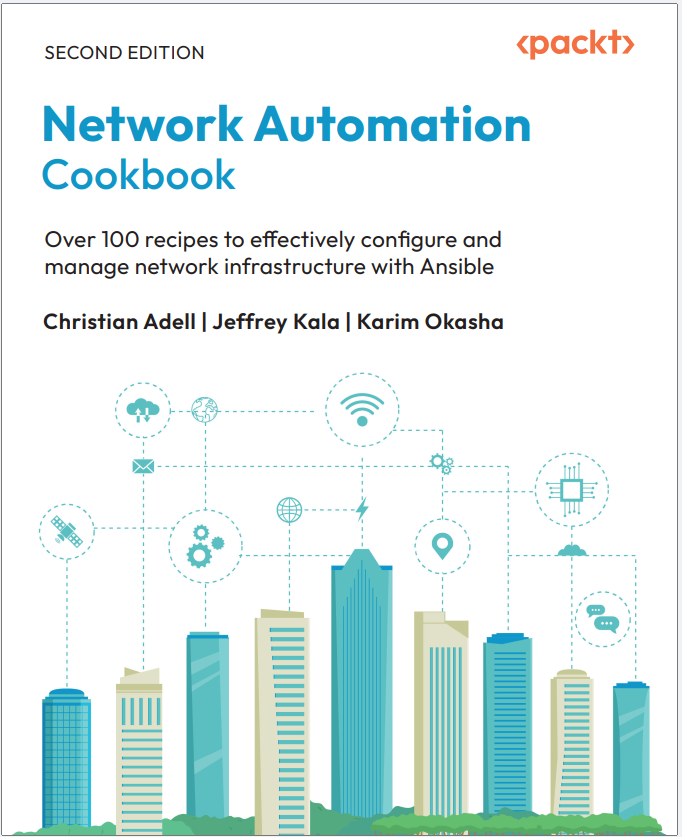
Network automation has been discussed for years, but for many network engineers it still feels abstract: promising in theory, intimidating in practice. Network Automation Cookbook, 2nd Ed., by Christian Adell, Jeffrey Kala, and Karim Okasha, positions itself as a practical bridge, offering more than 100 “recipes” that demonstrate how automation can be applied to real networking tasks, primarily using Ansible. This review reflects not only reading the book, but implementing and troubleshooting a significant subset of its recipes.
I approached this book with prior experience in networking, some familiarity with Ansible, and a general interest in how modern automation ecosystems fit together. Rather than reading it passively, I worked through a representative subset of chapters, implemented several labs, and spent time troubleshooting where things didn’t work as expected. This review reflects that hands-on experience.
Who This Book Is For
The book is best suited for network engineers who are new to automation and want to explore what is possible, as well as engineers who already use Ansible and are curious about integrating it with other tools such as Nautobot, Batfish, AWX, and Event-Driven Ansible (EDA).
That said, readers should be aware that the book assumes a baseline level of comfort with:
- Linux environments
- Container-based labs (notably Containerlab)
- Ansible fundamentals
Engineers without this background, especially students, may struggle without external guidance. In several places, I had to troubleshoot version mismatches, adjust playbooks, or infer missing steps. These challenges were manageable for me, but they could easily become discouraging for someone encountering these tools for the first time.
In that sense, this book is not a gentle introduction, but rather an exploratory one.
What the Book Is, and What It Isn’t
After finishing the book, the most accurate way I can describe it is this:
This book is best viewed as a demonstration of the power of automation using Ansible, rather than a comprehensive technical manual or a step-by-step guide to network automation.
The book’s full title “Network Automation Cookbook: Over 100 recipes to effectively configure and manage network infrastructure with Ansible” provides an explicit reference to Ansible. The emphasis is clear: Ansible is the center of gravity, and everything else orbits around it.
Chapter 1 introduces a broader network automation architecture, referencing concepts such as orchestration, source of truth, deployment, telemetry, and observability. The book attempts to cover all these components with various tools but telemetry and observability are largely absent.
Breadth Over Depth by Design
One of the defining characteristics of this book is its breadth. It exposes the reader to a wide range of tools and ideas rather than teaching a small set deeply.
This choice has trade-offs.
On the positive side, the book succeeds in showing:
- How Ansible fits into a broader automation ecosystem
- How different tools can be wired together
- What a “full” automation environment might look like
The book also employs multiple, unrelated lab topologies across chapters:
- Early chapters use a relatively complex multi-vendor topology
- Middle chapters shift to cloud-based infrastructures
- Later chapters use fewer devices in simples topology
For some readers, the shifting context can be confusing and makes it harder to build a cumulative mental model.
Hands-On Experience
From a practical standpoint, the hands-on experience is mostly smooth, with occasional bumps.
Some of the issues I encountered were:
- Discrepancies between the book and the GitHub repository
- Missing or mismatched environment variables
- Version sensitivity in third-party tools
- Assumptions not explicitly stated in the text
To be fair, keeping a book current in a fast-moving automation ecosystem is extremely difficult. I view these issues less as mistakes and more as a reflection of reality. Resolving them required troubleshooting, reading documentation, and occasionally modifying playbooks—activities that are very much part of real automation work.
However, this also means that a reader without prior experience is unlikely to resolve these issues independently. Without guidance, the friction could distract from the book’s core message and discourage further exploration.
Multi-Vendor Automation and BGP Complexity
One interesting design choice is the use of a multi-vendor topology with underlay and overlay BGP in early chapters. While this does showcase vendor diversity and different management interfaces, I’m not convinced it adds significant value to the objectives of the book.
In my view, the BGP complexity distracts from the primary goal: demonstrating automation patterns. A simpler routing model, such as OSPF in an enterprise topology or an eBGP-only spine-leaf fabric, would have conveyed the same automation principles with less cognitive overhead.
That said, the intent is clear: the authors aim to show realism, not toy examples.
Educational Value and Teaching Perspective
From an instructional standpoint, this book works very well as a reference and inspiration source. I would comfortably use it to:
- Design labs
- Demonstrate what automation can achieve
- Show students or engineers how tools fit together
For this reason, I see it as most appropriate for graduate students who can handle ambiguity or practicing engineers looking to expand their automation toolbox.
Readers seeking structured teaching material will need supplementary resources that explain automation concepts more systematically. For example, I would not assign this book directly to students, but I would comfortably use its ideas to design lab exercises that demonstrate configuration deployment, validation, and orchestration workflows.
What the Book Does Well
The book has several clear strengths:
- Tool exposure and breadth: Readers are introduced to a wide range of modern automation tools and workflows.
- Ambition: The book attempts to show an end-to-end automation environment rather than isolated scripts.
- Realism: The problems encountered—versions, integrations, and assumptions—mirror real automation projects
These qualities make the book a useful snapshot of how network automation is practiced today.
Final Verdict
I would recommend the book to network engineers who already have some familiarity with Ansible and want to expand its use and integrate it with other tools.
If you are comfortable with networking, Linux, and Ansible, and you enjoy learning by experimentation and troubleshooting, this book can serve as a blueprint for building a practical automation environment, with Ansible as the central orchestrator.
If, however, you are looking for a gentle introduction or a polished step-by-step guide, this book may feel challenging without additional resources.
For the right audience, though, it succeeds in its most important goal: making network automation feel tangible and achievable.